
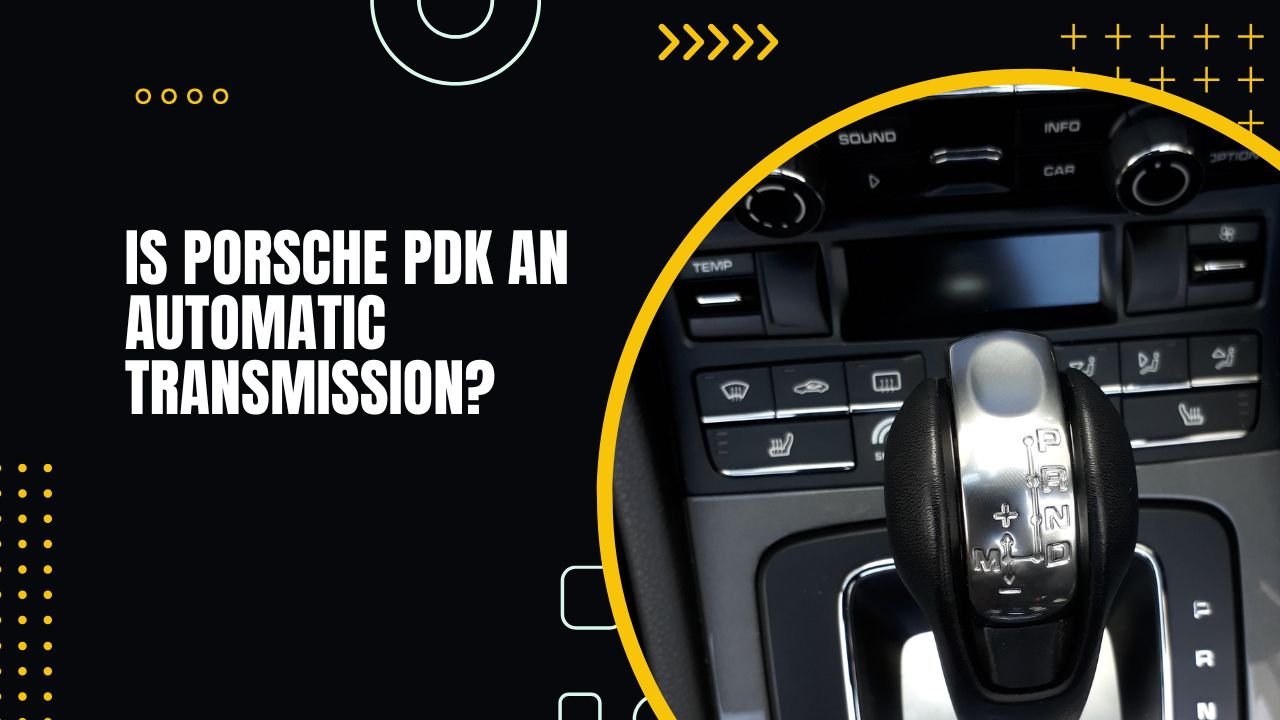
Is Porsche PDK An Automatic Transmission? Yes, Porsche PDK (Porsche Doppelkupplung) is a dual-clutch automatic transmission that offers both automatic and manual modes, providing fast, seamless gear shifts.
Porsche is synonymous with precision engineering and high-performance vehicles.
Over the years, Porsche has introduced several innovative technologies to enhance the driving experience, and one of the most significant advancements in recent times is the Porsche Doppelkupplung (PDK) transmission.
This technology has generated considerable debate among automotive enthusiasts and Porsche fans alike, particularly regarding whether PDK qualifies as an automatic transmission.
In this article, we will delve deep into the workings of the PDK transmission, compare it to traditional automatic systems, and explore its benefits.
By the end, you’ll have a clear understanding of whether Porsche PDK is an automatic transmission and why it’s such a game-changer.
What Is Porsche PDK?
Definition and Explanation
PDK stands for Porsche Doppelkupplung, which translates to “Porsche dual-clutch” in German. [Is Porsche PDK An Automatic Transmission?]
Essentially, the PDK transmission is a dual-clutch transmission system that uses two separate clutches to engage even and odd-numbered gears, allowing for quicker, smoother gear shifts compared to conventional transmissions.
This technology eliminates the delay often associated with manual gear shifting or even traditional automatic transmissions. As a result, PDK enhances both performance and fuel efficiency.
Unlike a standard automatic transmission, which relies on a torque converter, PDK uses a computer-controlled system to manage gear shifts between its two clutches. This setup enables lightning-fast changes with minimal power loss.
With PDK, drivers can switch between automatic and manual modes, giving them control over the driving experience based on their preferences or driving conditions. [Is Porsche PDK An Automatic Transmission?]
History and Development
The origins of PDK can be traced back to Porsche’s racing heritage. Initially developed for motorsport, PDK made its debut in Porsche’s Group C race cars in the 1980s.
The goal was to provide faster gear shifts without sacrificing performance during critical race conditions.
Given its success on the track, Porsche eventually introduced PDK to its road-going models, starting with the 911 Carrera in 2008. [Is Porsche PDK An Automatic Transmission?]
Since then, PDK has become a standard feature in many Porsche models, including the 718 Cayman, Panamera, and Macan.
Over the years, Porsche has refined and upgraded the PDK system, integrating it into both high-performance and luxury vehicles, making it a key component of the brand’s identity.
Is Porsche PDK Considered An Automatic Transmission?
Automatic vs. Manual Transmission
To understand whether PDK qualifies as an automatic transmission, it’s essential to break down the core differences between traditional manual and automatic systems.
- Manual transmission requires the driver to manually engage and disengage the clutch while shifting gears, providing full control over the car’s speed and performance.
- Automatic transmission, on the other hand, relies on a torque converter and does not require manual intervention for shifting gears, making it easier to drive for most users.
PDK occupies a unique space between these two. While it offers the convenience of an automatic transmission—especially in city driving or when cruising—PDK also allows the driver to manually shift gears when needed, using paddle shifters or the gear stick in manual mode.
How PDK Operates
The PDK system uses two separate clutches: one handles the even-numbered gears, and the other manages the odd-numbered gears. [Is Porsche PDK An Automatic Transmission?]
These clutches work in tandem to anticipate the next gear shift and engage it before the current gear is disengaged.
This dual-clutch design results in smoother, faster transitions between gears compared to a traditional automatic transmission.
When driving in automatic mode, the PDK transmission behaves like any other automatic system—handling gear changes based on driving conditions without any input from the driver.
However, when in manual mode, drivers can use paddle shifters mounted behind the steering wheel or the gear lever to take control of the shifting process.
This feature provides a thrilling, more engaged driving experience for those who want more control over their vehicle’s performance. [Is Porsche PDK An Automatic Transmission?]
5 Benefits of Porsche PDK
1. Fast Gear Shifts
One of the most significant advantages of PDK is its rapid gear shifts. Thanks to the dual-clutch system, gear changes happen in milliseconds, providing drivers with seamless power delivery.
Unlike traditional automatics, which can sometimes feel sluggish when changing gears, PDK ensures there’s virtually no delay between shifts.
This instantaneous response not only improves acceleration but also contributes to an overall more dynamic driving experience. [Is Porsche PDK An Automatic Transmission?]
2. Improved Performance
Porsche vehicles are known for their outstanding performance, and PDK plays a vital role in maximizing that performance.
The quick and smooth gear shifts that PDK offers translate into better acceleration and handling, particularly in sports cars like the Porsche 911.
Whether you’re on a racetrack or navigating twisty mountain roads, PDK helps maintain momentum and balance, allowing drivers to extract the most from their car’s engine.
Additionally, PDK’s precise control over gear shifts means that there’s less power loss compared to a traditional automatic transmission.
This makes PDK-equipped cars faster and more responsive, especially during spirited driving. [Is Porsche PDK An Automatic Transmission?]
3. Fuel Efficiency
In today’s world, fuel efficiency is an important factor for many car buyers, even those considering high-performance vehicles. PDK offers the best of both worlds by enhancing performance while also improving fuel economy.
The dual-clutch system minimizes the energy wasted during gear shifts, making the car more efficient than traditional automatic transmissions.
This is particularly useful during city driving, where stop-and-go traffic can typically lead to higher fuel consumption. [Is Porsche PDK An Automatic Transmission?]
Porsche’s PDK is specifically designed to optimize gear shifts based on driving conditions, ensuring the engine operates at its most efficient RPM range, which helps reduce fuel consumption without sacrificing performance.
4. Driver Engagement
One of the most compelling features of PDK is its ability to offer both automatic and manual modes. In automatic mode, PDK makes driving easy and convenient, particularly for daily commutes or long-distance highway cruising.
However, when drivers want to engage more directly with their vehicle, PDK can switch to manual mode, giving full control over gear selection.
Using the paddle shifters or the gear stick, drivers can shift gears as they would in a manual car, but with the added benefit of faster, more precise shifts.
This dual capability allows drivers to enjoy the best of both worlds: convenience when they need it and engagement when they want it.
5. Durability and Reliability
PDK is not only a high-performance transmission but also a reliable one. The dual-clutch system reduces wear and tear on the transmission components by distributing the load between the two clutches.
This makes the PDK system more durable and reliable, particularly under the high stresses of performance driving. [Is Porsche PDK An Automatic Transmission?]
Additionally, PDK-equipped cars are less prone to overheating during aggressive driving or in stop-and-go traffic, which is a common issue with some traditional automatic transmissions.
FAQs
1. Is PDK the same as a standard automatic transmission?
No, PDK is a dual-clutch transmission that functions similarly to an automatic in certain modes, but it offers faster, more efficient gear shifts and allows for manual control.
2. Can I drive a Porsche PDK in manual mode?
Yes, PDK offers a manual mode where you can shift gears using paddle shifters or the gear lever. [Is Porsche PDK An Automatic Transmission?]
3. What cars come equipped with PDK?
PDK is available in a wide range of Porsche models, including the 911, 718 Cayman, 718 Boxster, Panamera, and Macan.
4. How does PDK compare to a traditional automatic?
PDK provides faster gear shifts, better performance, and improved fuel efficiency compared to traditional automatic transmissions. It also offers the option of manual gear shifting for a more engaging driving experience.
5. Is PDK more expensive to maintain than an automatic transmission?
PDK maintenance costs can be slightly higher due to its complexity, but its reliability and performance benefits often outweigh the additional expense.
See Also: Does Porsche Taycan Qualify For Section 179?
Final Verdict
While PDK operates similarly to an automatic transmission in many ways, it is far more advanced and offers greater performance benefits.
The ability to shift quickly and seamlessly, combined with the option to manually control gear changes, makes PDK a standout feature in Porsche’s lineup.
It may not be a traditional automatic transmission, but it certainly brings the convenience of one with the added thrill of manual control.
Conclusion: Is Porsche PDK An Automatic Transmission?
Porsche PDK is a revolutionary transmission system that blurs the line between automatic and manual transmissions.
It offers the best of both worlds, providing convenience when needed and excitement when desired. [Is Porsche PDK An Automatic Transmission?]
Whether you’re driving on a daily commute or pushing your Porsche to its limits on a track, PDK enhances the experience in ways a traditional automatic transmission cannot.
If you’re considering a Porsche, opting for a model with PDK is a decision that will significantly enhance your driving experience.
