
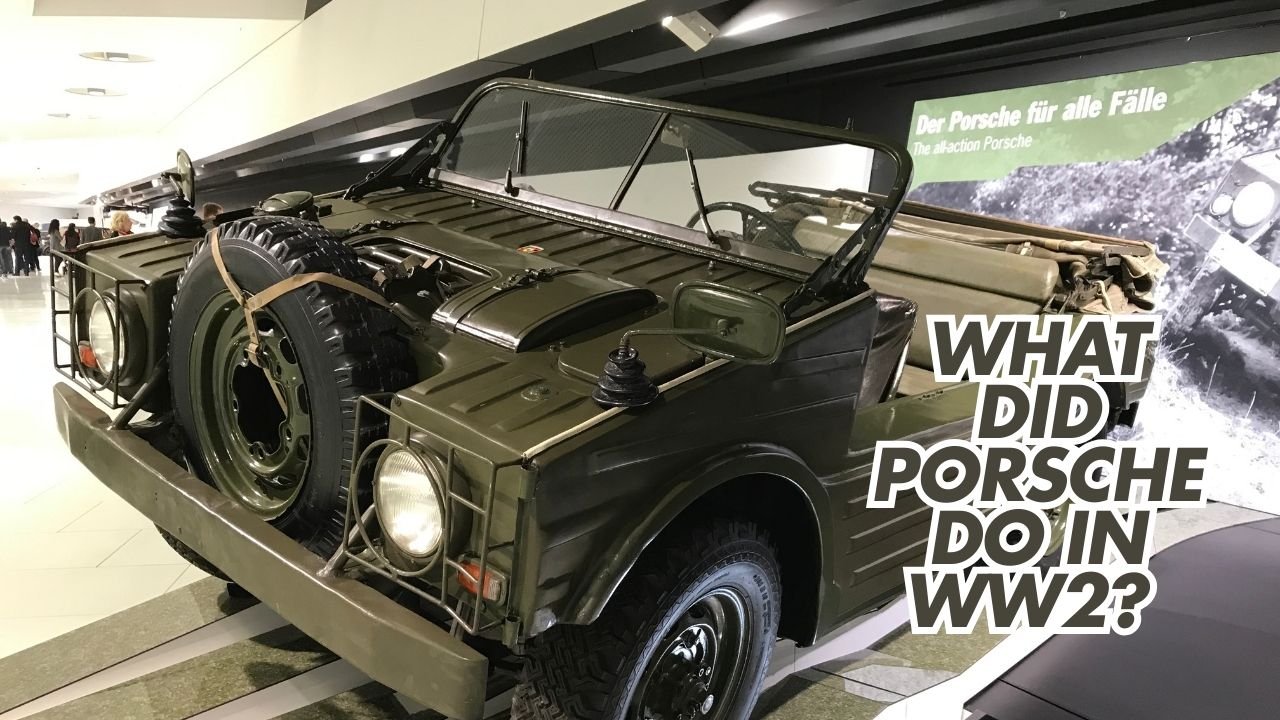
What Did Porsche Do In WWII? Porsche played a significant role in WWII by designing military vehicles, including the Tiger tank and contributing to the development of the Volkswagen Beetle
When we think of Porsche today, sleek sports cars and high-performance luxury vehicles come to mind. However, few people realize that Porsche has deep historical ties to World War II.
The company’s involvement in military projects and its relationship with the Nazi regime played a significant role in shaping its future.
In this article, we’ll explore Porsche’s activities during WWII, from designing military vehicles to its efforts in tank production, and examine how these endeavors impacted the company in the post-war era.
Porsche’s Early Role in WWII
Before Porsche became a renowned sports car brand, its founder, Ferdinand Porsche, was already making waves in the engineering world.
Ferdinand Porsche, an Austrian automotive engineer, had a longstanding passion for innovation and mechanical design. [What Did Porsche Do In WWII?]
His career began well before WWII, but his engineering expertise caught the eye of Adolf Hitler, which led to a pivotal collaboration between Porsche and the Nazi regime.
Ferdinand Porsche’s Relationship with the Nazi Regime
Ferdinand Porsche’s relationship with Adolf Hitler began in the early 1930s. Hitler, an admirer of automotive advancements, was particularly interested in making vehicles accessible to the general public.
As part of the Nazi regime’s ambition to revolutionize Germany’s transportation industry, Hitler enlisted Porsche to design the “people’s car,” which would later become the Volkswagen Beetle.
The project was part of the broader initiative to motorize Germany and align with the regime’s military and infrastructural ambitions. [What Did Porsche Do In WWII?]
This collaboration gave Ferdinand Porsche access to significant resources and placed him at the center of several key military and civilian engineering projects.
It also highlighted the dual nature of Porsche’s contributions to both civilian and military engineering efforts, as these two sectors often overlapped in Nazi Germany’s war-driven economy.
Development of the Volkswagen Beetle
The Volkswagen Beetle, originally known as the KdF-Wagen (Kraft-durch-Freude-Wagen or Strength through Joy Car), was designed by Porsche to be affordable, reliable, and mass-produced.
While the initial goal was to provide civilian transport, the onset of WWII saw the Beetle’s design adapted for military use.
Thus, the Beetle’s wartime evolution paved the way for its use in military roles, helping German forces traverse challenging terrains.
The military versions of the Beetle became essential for the German army. Its adaptability allowed it to become a highly versatile and practical vehicle during the war.
This marked one of Porsche’s early significant contributions to the Nazi war effort. [What Did Porsche Do In WWII?]
Porsche’s Contribution to Military Vehicles
Beyond the development of civilian cars, Porsche was also deeply involved in military vehicle production.
The war effort required specialized machinery for the battlefield, and Ferdinand Porsche applied his engineering expertise to this cause.
Kubelwagen and Schwimmwagen
The Kubelwagen, a military variant of the Beetle, became one of Porsche’s most successful wartime designs. [What Did Porsche Do In WWII?]
Light, durable, and capable of handling rough terrain, the Kubelwagen was used by the German army throughout the war.
It was often compared to the American Jeep, though the Kubelwagen had some advantages, such as being lighter and more fuel-efficient.
Its counterpart, the Schwimmwagen, was an amphibious version of the Kubelwagen, capable of traversing both land and water.
The Schwimmwagen became essential for German forces operating near rivers and other bodies of water, offering them flexibility in combat zones.
Both vehicles showcased Porsche’s ability to adapt designs to meet the unique demands of warfare. [What Did Porsche Do In WWII?]
These vehicles were heavily utilized in various combat situations, from the Eastern Front to North Africa. Their success helped cement Porsche’s reputation as a reliable military vehicle designer during the war.
Other Military Vehicle Contributions
In addition to the Kubelwagen and Schwimmwagen, Porsche contributed to other military vehicle designs, albeit to a lesser extent. [What Did Porsche Do In WWII?]
One such contribution was the development of electric vehicles for use in military environments, reflecting Ferdinand Porsche’s interest in alternative powertrains.
Although these projects did not achieve widespread use, they demonstrated Porsche’s forward-thinking approach to engineering, even in times of war.
Porsche and Tank Design During WWII
While Porsche’s work on civilian and military vehicles was significant, one of his most ambitious projects was his involvement in tank design.
Tanks were vital to the German war effort, and Porsche aimed to make a lasting impact in this area.
The Tiger I Tank Development
One of the most iconic tanks of WWII, the Tiger I, was partly shaped by Porsche’s influence. [What Did Porsche Do In WWII?]
The German military wanted a powerful, durable tank capable of dominating the battlefield, and Porsche competed with other manufacturers to develop the Tiger tank.
Porsche’s initial design was groundbreaking, featuring advanced engineering concepts such as electric transmission, a novel approach that aimed to give the tank greater mobility and power.
However, the electric transmission system made the design overly complex and difficult to manufacture. This design was innovative but faced technical challenges in terms of production scalability and field reliability.
The Failed Porsche Tiger Prototype
Porsche’s Tiger I prototype, despite its innovative electric transmission system, was plagued with technical issues.
The complexity of the system led to high production costs, maintenance difficulties, and mechanical breakdowns in the field. [What Did Porsche Do In WWII?]
This, coupled with a lack of sufficient raw materials during the latter stages of the war, meant that Porsche’s prototype was not feasible for mass production.
Ultimately, Henschel’s more practical design was chosen for mass production, and the Porsche Tiger prototype was abandoned after only a few were built.
Although unsuccessful in this endeavor, Porsche’s involvement in tank development reflected the company’s ambition to contribute significantly to the war effort.
Heavy Tank Prototypes and Armament Contributions
Despite the failure of the Tiger I prototype, Porsche continued its involvement in tank design, working on more ambitious projects aimed at providing the German military with even more powerful vehicles.
The Maus Super Heavy Tank
One of Porsche’s most audacious projects was the development of the Maus super heavy tank. The Maus was intended to be the largest and most formidable tank ever built, capable of withstanding nearly any attack on the battlefield.
With a weight exceeding 180 tons, the Maus was heavily armored and equipped with massive firepower. [What Did Porsche Do In WWII?]
However, its massive size and weight made it impractical for actual combat. It could barely move on most terrains and required special infrastructure, such as reinforced bridges, just to transport it.
The Maus was also extremely slow, limiting its effectiveness in combat situations where mobility was key.
Only two prototypes were produced before the project was scrapped due to its infeasibility and the shifting priorities of the German military as the war progressed.
The Maus tank remains one of the most iconic “what-if” vehicles of WWII, representing the extremes of military engineering and the often-overlooked challenges of translating advanced designs into practical battlefield solutions.
Porsche’s Role in Armament Manufacturing
Beyond vehicle design, Porsche also played a role in manufacturing parts and armaments for the German military. [What Did Porsche Do In WWII?]
The company’s factories were repurposed to meet the demands of war, producing essential components for a variety of military equipment.
This increased the company’s involvement in the overall Nazi war effort, further embedding Porsche in the history of WWII.
The company’s engineers and workers focused on producing various armaments, including engines and mechanical parts for other vehicles and tanks.
This level of contribution highlighted Porsche’s deep commitment to supporting the German military during the war, an involvement that would later have repercussions.
Post-War Impact on Porsche
With the conclusion of WWII, the German war machine collapsed, and so did the fortunes of those who had supported it.
Porsche, as a key player in the Nazi war effort, faced serious repercussions. [What Did Porsche Do In WWII?]
Ferdinand Porsche’s Arrest and Trials
After the war, Ferdinand Porsche was arrested by the French for his collaboration with the Nazi regime. [What Did Porsche Do In WWII?]
He was imprisoned for over 20 months without a formal trial, a reflection of how deeply his company had been involved in the Nazi military apparatus.
During this time, the company struggled to maintain its operations, with Ferdinand’s son, Ferry Porsche, taking over the reins and focusing on rebuilding the company.
While the legal ramifications of Porsche’s wartime activities were complex, the company managed to avoid being completely dismantled, unlike other firms that had contributed to the Nazi war effort.
Porsche’s Transition to Civilian Car Production
In the post-war years, Porsche transitioned from military to civilian car production. The company’s first post-war car, the Porsche 356, marked the beginning of a new era.
Designed by Ferry Porsche, the 356 was a sleek, performance-oriented car that quickly gained popularity among European car enthusiasts.
The 356 laid the foundation for the Porsche brand’s future success, helping it distance itself from its wartime past.
The company gradually rebuilt its reputation as a manufacturer of high-performance sports cars, with the Porsche 911 eventually becoming one of the most iconic vehicles in automotive history.
Despite its involvement in WWII, Porsche managed to pivot successfully toward a new identity in the automotive industry. [What Did Porsche Do In WWII?]
Final Verdict
Porsche’s involvement in WWII was extensive, from designing military vehicles like the Kubelwagen to developing ambitious tank prototypes like the Maus.
The company’s close ties with the Nazi regime and its contributions to the German war effort had significant consequences after the war, including Ferdinand Porsche’s arrest.
However, Porsche’s ability to pivot toward civilian car production in the post-war era allowed it to rebuild its reputation and ultimately become one of the most respected automotive brands in the world.
See Also: Does Porsche Cayenne Have Third Row?
FAQs
Did Porsche design tanks during WWII?
Yes, Porsche was involved in designing tanks, including the Tiger I prototype and the Maus super heavy tank. [What Did Porsche Do In WWII?]
What military vehicles did Porsche develop for Germany?
Porsche developed the Kubelwagen, Schwimmwagen, and contributed to tank designs like the Tiger I and Maus.
Why did Porsche’s Tiger tank prototype fail?
Porsche’s Tiger prototype was too complex and expensive to produce, leading to Henschel’s design being selected instead. [What Did Porsche Do In WWII?]
How was Ferdinand Porsche affected by WWII’s outcome?
After the war, Ferdinand Porsche was arrested by the French for his involvement with the Nazi regime and spent over 20 months in prison.
What is the legacy of Porsche’s role in WWII?
Porsche’s role in WWII remains a significant part of its history, but the company successfully reinvented itself post-war and became a leader in luxury sports car production.
Conclusion: What Did Porsche Do In WWII?
Porsche’s contributions during WWII were vast and complex, involving everything from civilian car design to advanced military vehicles. [What Did Porsche Do In WWII?]
While the company’s wartime activities were controversial, its ability to transition into a world-renowned car manufacturer after the war speaks to its resilience and adaptability.
The legacy of Porsche’s involvement in WWII serves as a reminder of the company’s roots, while its post-war success highlights its commitment to innovation and performance.
